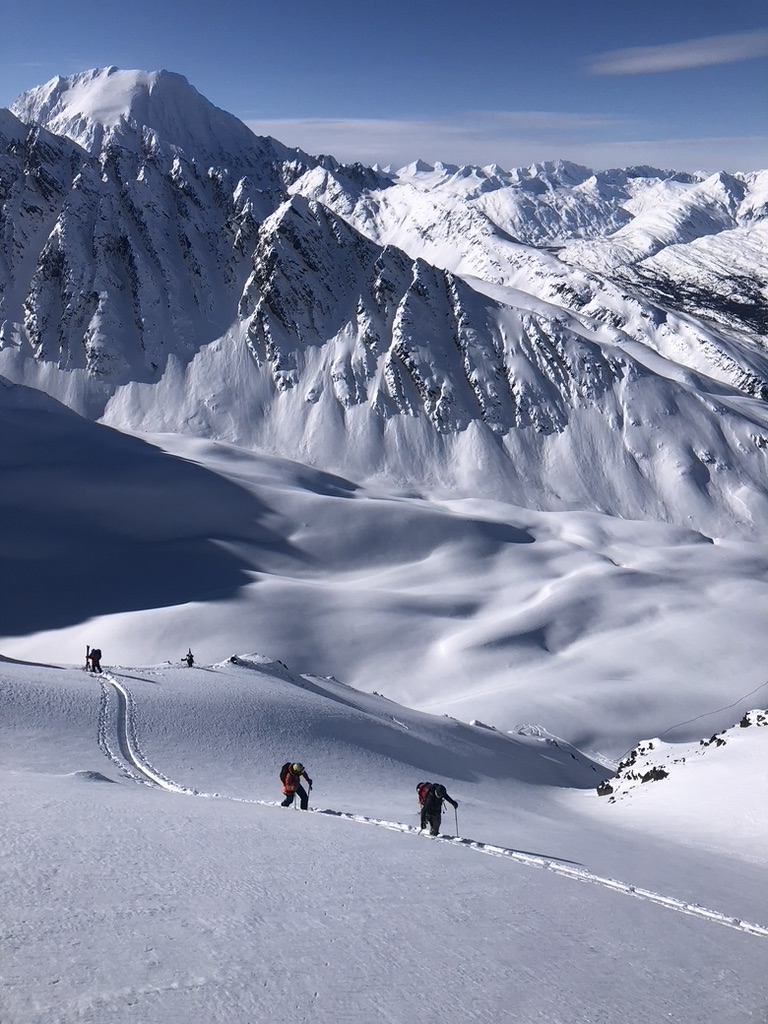
Skiing Alaska: Valdez, the Alaska Range, and Anchorage Backcountry
From Valdez couloirs that drop summit-to-road, to glacier basecamps in the shadow of Denali — Alaska delivers some of the most consequential and rewarding ski mountaineering on the planet. ITCOG guide Todd Passey breaks down three distinct zones of Alaskan skiing.
Alaska: The Last Frontier for Ski Mountaineers
Alaska doesn't whisper. It doesn't ease you in. From the moment your plane drops below the cloud deck and the terrain comes into view — jagged ridgelines, glaciated faces, couloirs carved by millennia of freeze and thaw — you understand that this place operates on a different scale entirely.
And then there's the Alaska Factor. Everything is bigger than it looks on approach. A line that appears moderate from the glacier turns out to be a sustained, steep couloir. A "short" skin to the ridge takes four hours. The scale here recalibrates your sense of what mountains are.
Over the past two decades of guiding in Alaska, I keep coming back for the same reasons: the skiing is massive, the access is surprisingly good, and nowhere else on Earth rewards human-powered travel through the mountains quite like this state.
Here's how I think about skiing Alaska in three distinct chapters.
Chapter One: Valdez — The Birthplace of Extreme Skiing
If you want to understand where modern extreme skiing was born, you go to Valdez.
In the 1990s, a generation of freeskiers — Doug Coombs, Kim Reichhelm, and others — descended on the Thompson Pass area and systematically skied lines that had never been touched. They used helicopters to access terrain, yes, but they also just showed up and climbed. They made Valdez famous through the raw, committed act of getting after terrain so steep it barely seems possible.
What makes Valdez special isn't just the steepness. It's the accessibility. Thompson Pass sits at roughly 2,600 feet right off the Richardson Highway. The peaks above it rise another four to five thousand feet, packed with couloirs, faces, and ridgelines that drain directly to the road.
Human-Powered Valdez: Summit to Road
What we do in Valdez is entirely human-powered — skin up, ski down, car waiting at the bottom. No helicopter, no snowcat. Just your legs, your lungs, and your partners.
You boot pack up steep couloirs, crampons biting into the snow, ice axe in hand. The exposure is real. The climbing is serious. And then you reach the ridge, clip into your skis, and make turns from the summit all the way to the road.
Summit to road. Think about that. There is very little approach here — you park, you climb, and you ski good turns all the way back to the car. Continuous vertical from top to bottom. There is nowhere on Earth I've found that combines this quality of terrain with this kind of direct access.
The descents are long — often 4,000 to 5,000 vertical feet. I run my Valdez trips in late March and early May, and the snow is often powder — dry and cold, especially on north-facing terrain. Some days in late March you're skiing knee-deep on faces that haven't seen a skier all winter. Even in May, when you might expect spring conditions, shaded aspects often hold excellent snow from recent storms.
Valdez is where I take skiers who are ready to find out what they're made of.
Chapter Two: The Alaska Range and Denali National Park
From Valdez, we turn our eyes north. The Alaska Range is one of the great mountain massifs on the planet — a 400-mile arc of peaks that includes Denali (20,310 ft), Mount Foraker, Mount Hunter, and hundreds of lesser-known but equally dramatic objectives.
This is where ski mountaineering stops being recreational and starts being something closer to exploration. The scale is Himalayan. The glaciers are crevassed and demand awareness and sometimes rope travel. And the skiing is unlike anything I've experienced anywhere in the world.
Denali National Park encompasses much of the central Alaska Range, a protected wilderness of roughly six million acres. Within its boundaries, rivers of glacial ice flow between walls of granite and ice-capped summits. It is, in every sense of the word, wild.
The weather in the Alaska Range has a reputation for being serious, and it can be. But it can also be magnificent — long stretches of high pressure, bluebird skies, and light that turns the peaks gold for hours at a time. Splitter weather in the Alaska Range is as real as the storms, and when you get it, there is nowhere better on Earth.
Flying in with Talkeetna Air Taxi
Access to the Alaska Range is by ski plane, and the gateway is the small town of Talkeetna — a scattering of cabins, a legendary roadhouse, and the operations base for the bush pilots who have been flying climbers and skiers into these mountains for generations.
We fly with Talkeetna Air Taxi, one of the most experienced glacier flying operations in the world. Their fleet is primarily de Havilland Beavers and Otters fitted with wheel-skis, flown by pilots with thousands of hours of glacier landings behind them. The precision they bring to setting a plane down on a remote glacier neve never gets old.
The flight in is part of the experience. You bank over boreal forest, cross the Susitna River, and then the terrain rises suddenly and dramatically. You're threading between peaks that dwarf anything in the lower 48. The pilot reads the snow surface from 200 feet, picks a landing zone, and sets you down with a gentle shush of skis on glacier ice.
And then the plane turns around and leaves. And it's just you.
Chapter Three: Little Switzerland, Pika Glacier, and the Surrounding Pocket Glaciers
Little Switzerland is the name of the entire zone — a world-class cluster of glaciers and granite peaks tucked into the southern Alaska Range near the Ruth Gorge and the Pika Glacier drainage. It's one of the finest places I've ever skied, and most people outside the Alaska guiding community have never heard of it.
This is where we set up our basecamp, and here's what surprises most people when they arrive: it's a lot like car camping.
I mean that seriously. When the Otter touches down and offloads your gear on the skiway, camp is roughly 200 meters away. You're not looking at a five-mile slog to establish your base. There is essentially no approach. Your skis go on at your tent door in the morning and come off at your tent door in the evening.
Because we don't have to carry everything on our backs through miles of difficult terrain, we can afford to be genuinely comfortable. We bring real sleeping pads. We bring a proper kitchen setup. We bring the good coffee. The experience of living on the glacier in Little Switzerland is not about suffering through it to get to the skiing — it becomes the perfect, comfortable basecamp for accessing exceptional powder skiing in one of the most inspiring settings on Earth.
Basecamp Life
We place tents toward the middle of the glacier, on a subtle ridge in the ice — the spot that catches the most sunshine through the day. Sun matters enormously in the Alaska Range. April days are long and brilliant, and a campsite that basks in direct light from mid-morning to evening is a warm, drying, morale-sustaining thing. We cook hot meals twice a day, mark safe travel routes with wands, and spend evenings looking up at the faces we skied and the ones we're planning for tomorrow.
Sleeping on a glacier at 7,000 feet sounds austere. In practice, it becomes something you genuinely don't want to leave — a perfect fun and comfortable base for everything the terrain around you has to offer.
The Skiing: Powder, Couloirs, and Pocket Glaciers
We run our Alaska Range trips in late March through April, and the conditions are typically exceptional. This past season we had powder every single day of the trip. On our last day we were skiing over two feet of fresh snow. That's not a fluke — that's what Alaska does in spring.
What Little Switzerland and the surrounding pocket glaciers offer is staggering variety:
- Long glacier descents dropping two to three thousand feet on open névé, big open turns on a surface that seems to go on forever
- Technical couloirs that demand bootpacking and careful route-finding before rewarding you with a thousand feet of steep, sustained powder skiing
- Pocket glaciers tucked into cirques above the main drainage — sheltered, often loaded with wind-deposited snow, and consistently excellent throughout the trip
- Short overnight excursions — packing a very light ski kit to tag a specific objective or simply explore a new zone, spending a night out and returning to basecamp the next day
Remember the Alaska Factor. That pocket glacier that looks like a short jaunt from camp? It's a two-hour skin. That couloir that looks moderate from below? You'll be grateful you brought your crampons. The scale here constantly exceeds your first impression, which means there is always more skiing than you expect — and it's always bigger and better than it looked from a distance.
Who These Trips Are For
Alaska skiing — whether in Valdez or the Range — is not for beginners. But it's also not exclusively for elite alpinists.
For Valdez, you need to be a strong, confident skier on steep and variable terrain, comfortable bootpacking with crampons and an ice axe, and physically prepared for multi-thousand-foot days.
For the Alaska Range, you need all of the above plus comfort traveling on a glacier, some familiarity with crevasse terrain, and the patience to embrace down days when weather moves in.
What both zones reward equally is attitude. The clients who get the most out of Alaska are curious, patient, and willing to let the mountain set the agenda.
Alaska will recalibrate what you think skiing can be.
Contact us to talk through which Alaska objective is right for your skill level and goals.